
Navratri and Vedic Astrology: How Are the Nine Days Connected to Your Kundli?
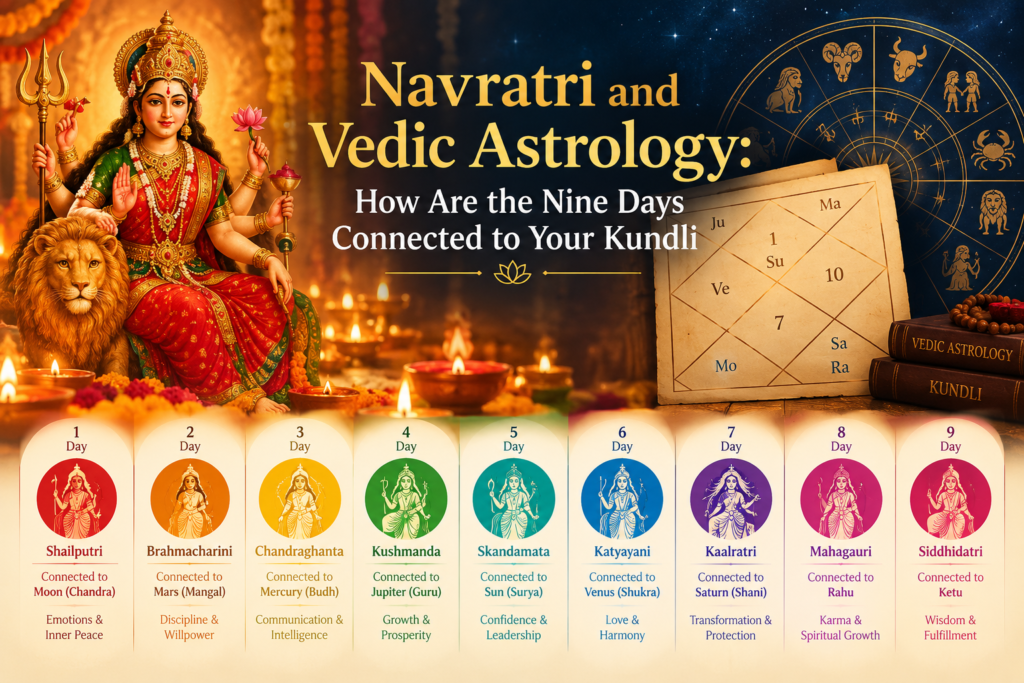
Navratri astrology explores how the nine nights of Navratri relate to the Navagraha, the nine grahas of Vedic astrology, and to your personal Kundli. The link is traditional and symbolic. Navratri honours the Navadurga, while a Kundli is a birth chart calculated from your birth details.
Sharad Navratri 2026
11 – 19 October 2026 | Dussehra on 20 October
This article explains how these ideas connect, where traditions differ, and what a personal birth chart adds. Nine nights of devotion naturally invite curiosity about the planets.
What Is the Significance of Navratri in Vedic Astrology?
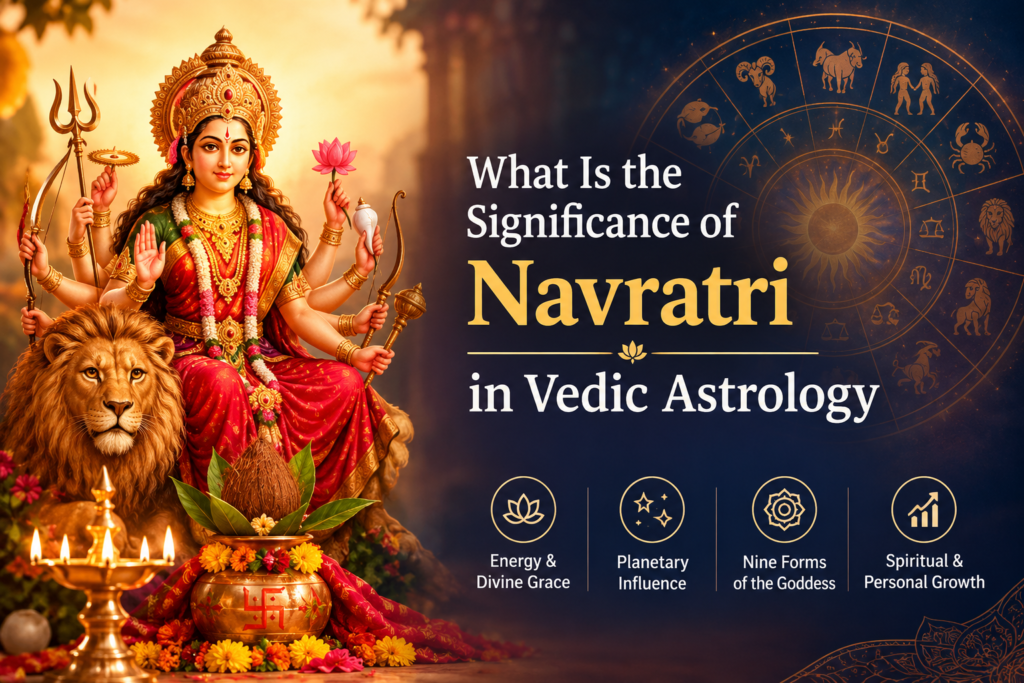
Navratri is a nine-night Hindu festival honouring Goddess Durga. In Navratri astrology, many practitioners regard it as a favourable period for prayer and discipline, not as a fixed planetary event.
It helps to separate three things:
📷 Religious Belief
Hindu mythology describes the nine nights as stages of Durga’s battle with Mahishasura, ending with Vijayadashami.
🌟 Astrological Interpretation
Practitioners link festival rituals to planetary themes. This is interpretation, and it differs across regions and lineages.
🔲 Astronomical Fact
Sharad Navratri begins on Ashwin Shukla Pratipada, set by the lunar Hindu calendar. Science has not established that planetary positions shape personal outcomes.
How Are Navratri, Navadurga, and Navagraha Connected?
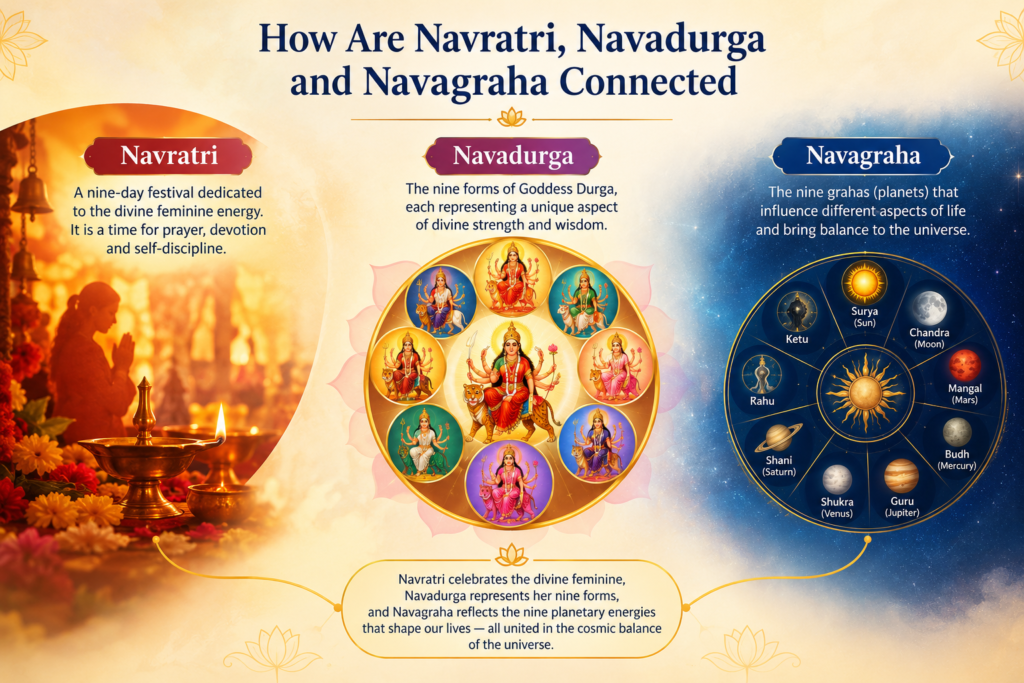
Both groups have nine members, which invites comparison. Some popular sources pair each Devi with a graha, such as Shailaputri with the Moon and Brahmacharini with Mars. However, published lists vary, and no single mapping is accepted by every tradition.
🌟 Navadurga (Nine Forms)
⚖ Navagraha (Nine Grahas)
⚠ This article does not present any one pairing as settled. Readers can ask their family priest or a qualified astrologer about their own tradition.
Can Your Kundli Help You Understand Planetary Influences?
A Kundli, or birth chart, is a map of the sky at the time and place of your birth. In Vedic astrology, it records the nine grahas across twelve houses and zodiac signs. The ascendant (Lagna) is the sign rising on the eastern horizon at birth, and it fixes the house layout.
🕐 What a Kundli Records
- ✦Nine grahas across 12 houses
- ✦Zodiac signs (Rashis)
- ✦Lagna (Ascendant)
- ✦Nakshatras & Dashas
🔒 What It Needs
- ✦Exact date of birth
- ✦Exact birth time
- ✦Place of birth
- ✦Personal consultation
Your chart depends on your birth details, not on the Navratri calendar, so festival-based Navratri astrology stays general. Astrology is a traditional belief system, not a scientifically proven method, and no reading can guarantee outcomes.
What Is the Role of Navratri Rituals and Grah Shanti?
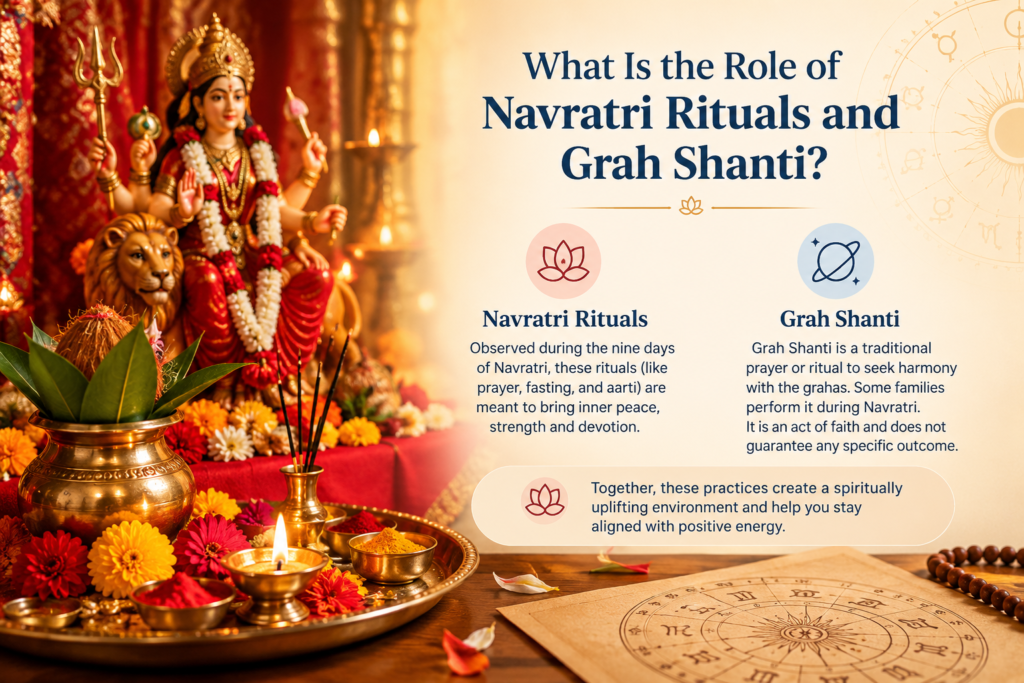
Navratri rituals centre on devotion. Households typically begin with Ghatasthapana on the first day, worship one Navadurga form each day, and some observe fasts.
💭 What Is Grah Shanti?
Within Navratri astrology, Grah Shanti is a traditional prayer or rite performed to seek harmony with the grahas. Some families choose to perform it during Navratri, which they consider an auspicious period. It is an act of faith.
⚠ Grah Shanti should not be read as a promise of altered planetary effects, wealth, marriage, career success, or better health. Practices differ by region and lineage — consult a trusted religious or astrological source for tradition-specific guidance.
When Should You Consider an Online Kundli Prediction?
Consider an online Kundli prediction when you want a structured reading of your own birth chart rather than general festival symbolism. You need your date of birth, exact birth time, and birthplace. Time and place determine the ascendant and house positions, so small errors can change the chart.
A Traditional Consultation May Cover:
- ✦Planetary positions and signs (Rashis)
- ✦Houses (Bhavas) and the Ascendant (Lagna)
- ✦Dasha periods and their timing
- ✦Nakshatras and their influence
Conclusion
Navratri astrology connects a devotional festival with symbolic ideas from Vedic astrology, mainly the Navadurga and the Navagraha. These links are traditional and vary across communities. General festival interpretations cannot replace a personalised reading based on your birth details.
If you wish to understand your own chart, you can explore an online Kundli consultation with Jyoti Vora.
Frequently Asked Questions
What is the significance of Navratri in Vedic astrology?
In Navratri astrology, the festival is viewed as a spiritually favourable period for prayer and self-discipline. It is a festival tradition rather than a fixed planetary event. Interpretations vary widely by region, family custom, and individual astrologer.
Are Navadurga and Navagraha connected?
Both sets have nine members, and some popular sources pair each Devi with a graha. However, no single mapping is accepted by every tradition. Treat such pairings as tradition-specific beliefs and verify them with a trusted source.
Can Kundli reveal planetary positions?
Yes. A Kundli records where the nine grahas were placed by sign and house at birth, using your date, time, and place of birth. How those positions influence life is a matter of interpretation, not proven fact.
What is Grah Shanti during Navratri?
Grah Shanti is a traditional prayer or ritual performed to seek harmony with the grahas. Some families perform it during Navratri. It is an act of faith and does not guarantee any specific outcome in life.
Is Navratri astrology the same as a personal Kundli prediction?
No. Navratri astrology offers general, festival-based symbolism for everyone. A personal Kundli prediction relies on your own birth date, time, and place. The first is cultural and broad; the second is individual and chart-based.
Want to Understand Your Own Kundli This Navratri?
Go beyond festival symbolism — book a personalised Vedic astrology consultation based on your birth details.