
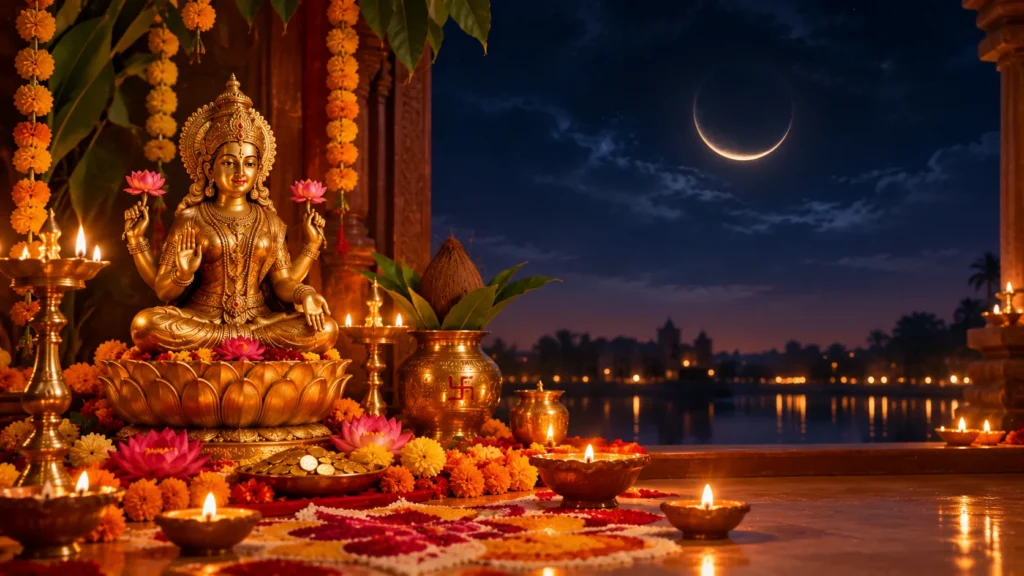
Lakshmi Puja during Diwali is a ritual to honour Goddess Lakshmi, traditionally associated with prosperity, abundance and gratitude. Its meaning is spiritual first. Families clean their homes, light lamps and give thanks. Astrology adds a calendar layer, because the puja falls on Amavasya, the new-moon night of the Hindu month of Kartika. This article explains the festival’s significance, the planets traditionally linked with prosperity, and how personal birth-chart analysis differs from general beliefs. No ritual can guarantee financial success.
What Is the Astrological Significance of Lakshmi Puja?
The astrological significance of Lakshmi Puja lies mainly in its timing and symbolism. Traditionally, the puja is performed on Diwali Amavasya during Pradosh Kaal, the evening twilight after sunset. Panchang calculations (the Hindu almanac) fix this muhurta, or auspicious window. Goddess Lakshmi is worshipped as the giver of fortune, which is why Lakshmi puja significance is so often tied to prosperity and new beginnings. Some families spell it Laxmi Puja.
It helps to separate two ideas. Devotional belief holds that sincere worship invites Lakshmi’s blessings. Vedic astrology, by contrast, studies the planetary positions at a person’s birth. The festival offers shared meaning, while a Kundli (birth chart) offers personal context. Traditions explain the puja differently, and neither approach replaces practical effort.
Why Is Lakshmi Puja Associated with Diwali Amavasya?
Lakshmi Puja is associated with Diwali Amavasya because the festival’s main night falls on the new moon of Kartika in most Hindu calendars. Amavasya is the lunar phase when the Moon is not visible and sits close to the Sun. Lighting lamps on this darkest night symbolises hope, renewal and the victory of light over darkness.
Several traditions explain the connection. One narrative says Lakshmi emerged during Samudra Manthan, the churning of the cosmic ocean. Another associates the night with Lord Rama’s return to Ayodhya. Regional practice also varies. Bengal, Odisha and Assam worship Lakshmi at Kojagara Puja on the full moon of Ashwin, and many eastern homes observe Kali Puja on Diwali night.
Which Planets Are Traditionally Associated with Prosperity?
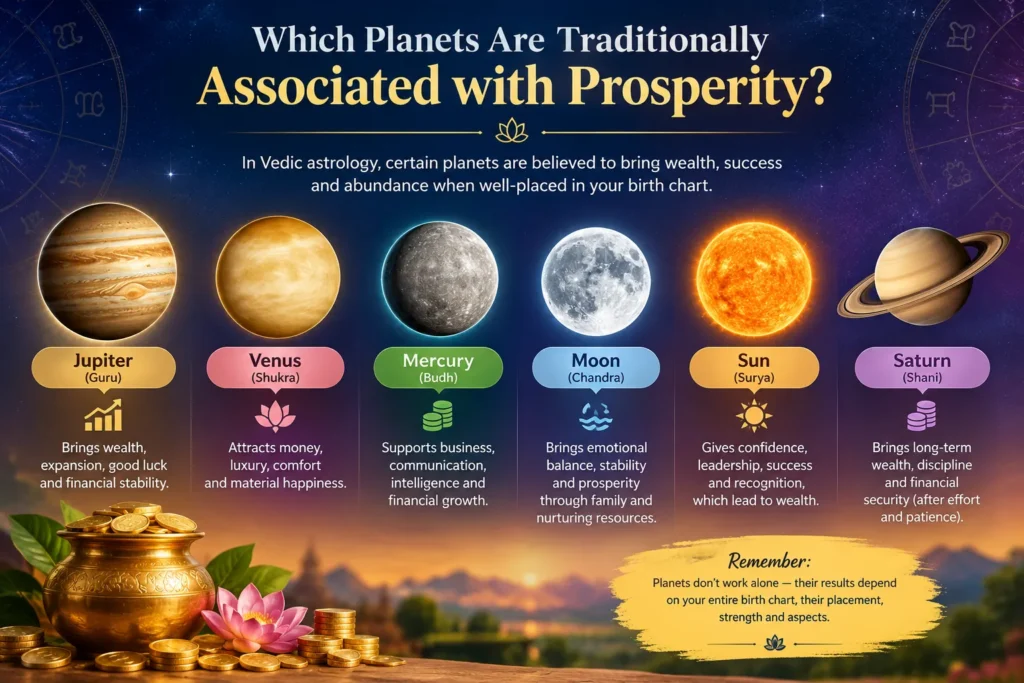
Vedic astrology links prosperity most often with Venus and Jupiter. Shukra (Venus) signifies comfort, luxury, relationships and material enjoyment. Guru (Jupiter) signifies wisdom, growth, ethical judgement and good fortune. Classical texts treat Jupiter as the natural significator, or karaka, of wealth. Interpretations vary by tradition, and the overall chart matters more than any single planet.
The Moon is also relevant, with care. It represents the mind and emotional steadiness. On Amavasya, the Sun and Moon share the same position in the zodiac. Diwali Amavasya usually occurs when the Sun is in Tula (Libra) in the sidereal zodiac, a sign ruled by Venus. This is a calendar observation, not proof of any financial outcome.
Some readers ask about gemstone guidance in Vedic astrology. Traditionally, diamond or white sapphire is associated with Venus and yellow sapphire with Jupiter. These are traditional associations, not proven financial solutions, and are best discussed with a qualified practitioner first.
How Does Vedic Astrology Interpret Prosperity in a Personal Kundli?
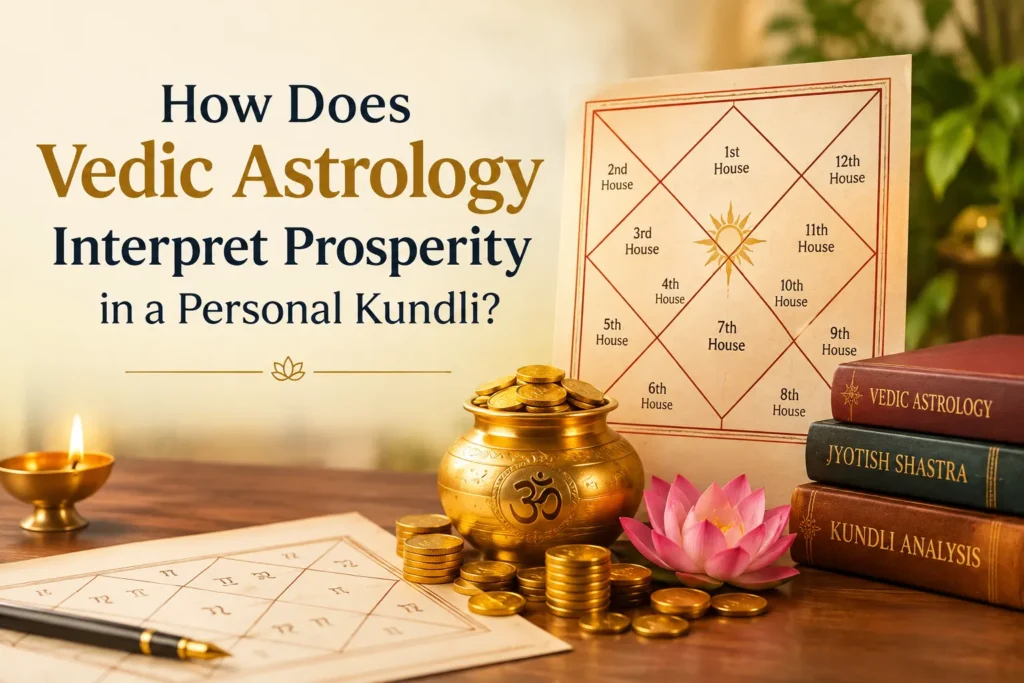
A Kundli is a birth chart showing planetary positions at your time and place of birth, divided into twelve houses (bhavas). Vedic astrology interprets prosperity through several houses together:
2nd house
accumulated resources, savings, speech and family values.
9th house
fortune (bhagya), dharma and guidance from mentors.
10th house
career, status and public recognition.
11th house
income, gains, networks and fulfilment of goals.
Astrologers do not read these houses alone. They also study house lords, planetary strength, aspects and the dasha, the planetary period running at a given time. A strong 11th house, for example, does not promise wealth by itself. A Kundli describes tendencies and timing themes. It cannot predict financial outcomes with certainty.
Would you like to understand how Vedic astrology traditionally interprets your birth chart? Explore an online Kundli prediction with Jyoti Vora for personalized astrological guidance.
Does Lakshmi Puja Have the Same Astrological Meaning for Everyone?
No. The festival’s traditions are shared, but astrological interpretation is individual. Everyone who performs Lakshmi Puja takes part in the same cultural and spiritual observance. The importance of Laxmi Puja in Diwali, though, is understood through faith, family custom and personal circumstances, not through one chart pattern.
Two people may worship on the same night yet have very different birth charts, planetary periods and life situations. A planetary association that is significant in one chart may be minor in another. Rituals and astrology also do not replace budgeting, skilled work, savings discipline or advice from a qualified financial professional.
When Can a Personal Astrology Consultation Be Helpful?

A consultation can help when you want to understand your chart in plain language. Many people find terms like lagna (ascendant), dasha and house lord confusing. An astrologer can explain what these mean and how traditional texts interpret them, so you can reflect on your own circumstances.
It may also help if you are curious how the 2nd, 9th, 10th and 11th houses appear in your chart. Treat the discussion as educational guidance, not a promise of results. A personalized Kundli reading begins with accurate birth details: date, exact time and place.
Frequently Asked Questions
What is the astrological significance of Lakshmi Puja during Diwali?
Lakshmi Puja during Diwali honours Goddess Lakshmi as a symbol of prosperity and gratitude. Astrologically, it is linked to Amavasya, Pradosh Kaal and traditional planetary themes such as Venus and Jupiter. These are interpretive traditions, and they do not guarantee financial outcomes.
Why is Lakshmi Puja performed on Diwali Amavasya?
Diwali falls on the new-moon night of Kartika, and Lakshmi Puja is the festival’s central evening ritual. The dark night, lit by lamps, symbolises renewal. Narratives such as Lakshmi’s emergence during Samudra Manthan add meaning, though regional customs differ.
Which planets are traditionally associated with prosperity in Vedic astrology?
Venus (Shukra) and Jupiter (Guru) are most commonly associated with prosperity. Venus relates to comfort and material enjoyment, while Jupiter relates to growth, wisdom and fortune. Astrologers judge them within the whole chart, not as standalone guarantees.
How does Vedic astrology interpret prosperity in a Kundli?
Astrologers study the 2nd, 9th, 10th and 11th houses, their lords, planetary strength and dashas. Together, these indicate themes around resources, fortune, career and gains. The reading is interpretive and does not predict exact financial results.
Can an astrologer explain prosperity-related indicators in a personal birth chart?
Yes. An astrologer can explain how traditional texts interpret prosperity-related indicators in your Kundli, such as house placements and planetary periods. This helps you understand tendencies. It should not replace professional financial advice or be treated as certainty.
Does performing Lakshmi Puja guarantee financial prosperity?
No. Lakshmi Puja is a devotional and cultural practice, not a financial guarantee. Many people perform it for gratitude, focus and family unity. Financial stability still depends on planning, effort and sound decisions.