

Vedic Astrology: Meaning, Basics, and How It Works
Vedic Astrology is an ancient Indian astrological system, also known as Jyotish, that studies planetary positions to understand personality, life patterns, and periods of change. Unlike a daily horoscope, which applies one broad prediction to everyone born under a zodiac sign, Vedic Astrology uses a person’s exact date, time, and place of birth to build a Kundli, or birth chart, as the foundation for a personalized reading. If you’re new to it, here is what it means, how it works, and what it can help you understand.
Table of Contents
- 01What Is Vedic Astrology?
- 02What Does Jyotish Mean?
- 03How Does Vedic Astrology Work?
- 04What Are the Main Elements of Vedic Astrology?
- 05How Does a Vedic Astrologer Read a Kundli?
- 06What Can Vedic Astrology Help You Understand?
- 07Vedic Astrology vs Daily Horoscope
- 08Can Vedic Astrology Predict the Future?
- 09FAQs
What Is Vedic Astrology?
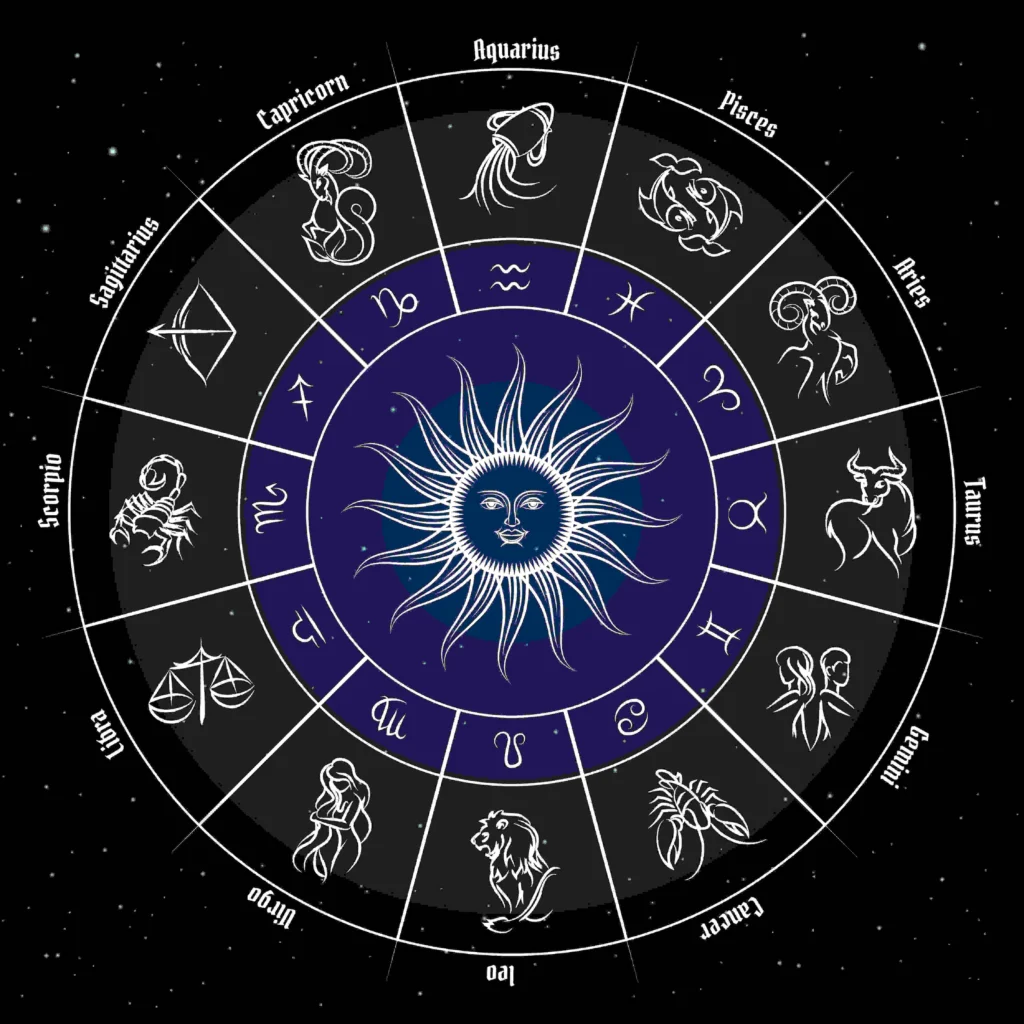
Vedic Astrology, also called Jyotish, is a traditional Indian system of astrology that dates back thousands of years. It is based on the idea that planetary positions at the moment of birth reflect certain life patterns and tendencies. Practitioners use exact birth details to calculate a Kundli, mapping where each planet sat across the zodiac at that moment.
Unlike Western astrology, widely known through daily horoscope columns, Vedic Astrology relies on a detailed, individual chart rather than a single sun sign. It considers several factors together, including planets, houses, and constellations, to build a layered picture of a person’s life. It is a traditional interpretive practice, not a scientifically proven predictive system, and is best approached with that understanding.
What Does Jyotish Mean?

Jyotish is the Sanskrit term for Vedic Astrology, commonly translated as “the science of light.” The word refers to the light of celestial bodies, the sun, moon, planets, and stars, and their traditional role in reflecting patterns in human life. Jyotish is regarded as one of the traditional Vedic sciences, historically used to interpret cosmic influences and offer guidance around important life decisions.
How Does Vedic Astrology Work?
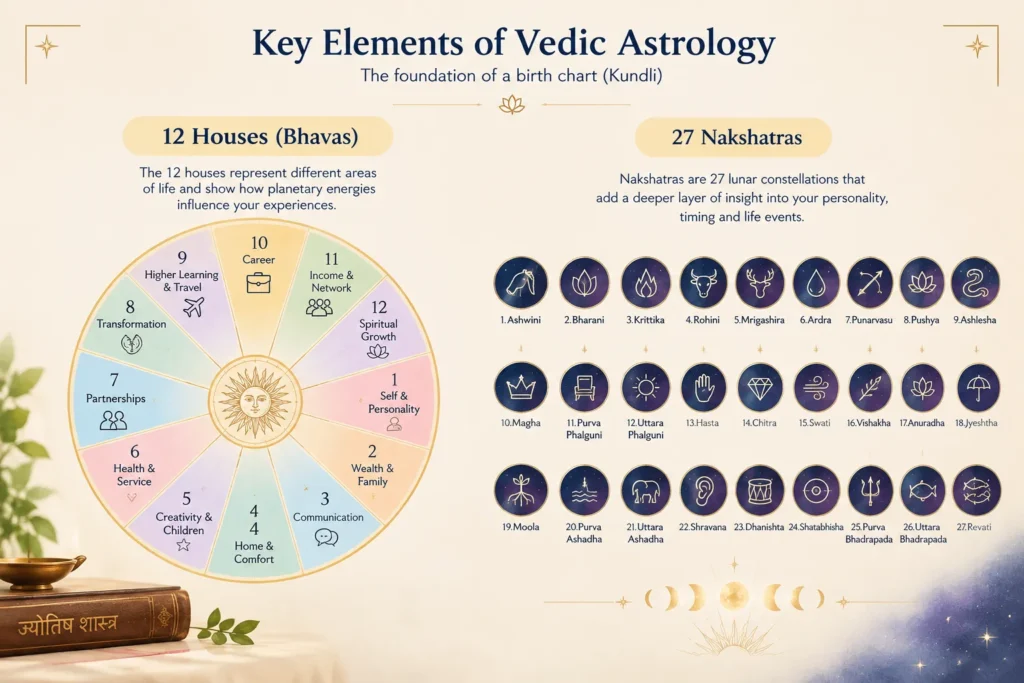
A Vedic Astrology reading begins with three details: date, exact time, and place of birth. These are used to calculate the Kundli, a chart showing where each planet was positioned at that moment.
From the Kundli, an astrologer identifies the Lagna, or ascendant, along with the Rashis (zodiac signs), the 12 houses, and the Nakshatras (lunar constellations) relevant to the individual. Planetary periods, known as Dashas, and current transits, or Gochar, are then layered onto this framework.
Vedic Astrology does not rely on a single zodiac sign. A personalized reading considers these factors together. Because planetary positions shift over time, an accurate birth time matters — even a small difference can change key details in the chart.
What Are the Main Elements of Vedic Astrology?
A few core concepts appear in almost every Vedic Astrology reading:
Kundli / Birth Chart
A map of planetary positions at the exact time of birth, used as the base for interpretation.
Lagna / Ascendant
The sign rising on the eastern horizon at birth, often treated as the chart’s reference point.
Rashis / Zodiac Signs
The twelve signs showing where each planet was placed within the chart.
Navagraha / Nine Grahas
The nine planetary influences used in Vedic Astrology, including the sun, moon, and lunar nodes.
12 Houses / Bhavas
Sections of the chart, each linked to an area of life, such as career or relationships.
27 Nakshatras
Lunar constellations that add another layer of detail to a planet’s placement.
Each of these deserves its own detailed explanation, covered in dedicated guides. Here, the goal is simply to introduce the framework.
How Does a Vedic Astrologer Read a Kundli?
A Vedic astrologer does not typically interpret a chart from the Moon sign or Sun sign alone. A reading usually considers the Lagna, planetary placements, Rashis, houses, and Nakshatras together, along with how planets relate to one another, then adds Dashas and transits to understand timing.
These factors are studied as a combined picture rather than in isolation, which is what allows a reading to move beyond a generic zodiac description and toward an interpretation reflecting an individual’s specific birth details.
What Can Vedic Astrology Help You Understand?
Vedic Astrology is traditionally used to explore career direction, relationships, marriage compatibility, personal tendencies, strengths and challenges, and potentially significant life periods. For a more detailed, individual perspective, many people choose an online astrology consultation to have their Kundli interpreted directly.
| ✦Career direction | ✦Relationships |
| ✦Marriage compatibility | ✦Personal tendencies |
| ✦Strengths and challenges | ✦Significant life periods |
Vedic Astrology vs Daily Horoscope
Daily Horoscope
|
Vedic Astrology
|
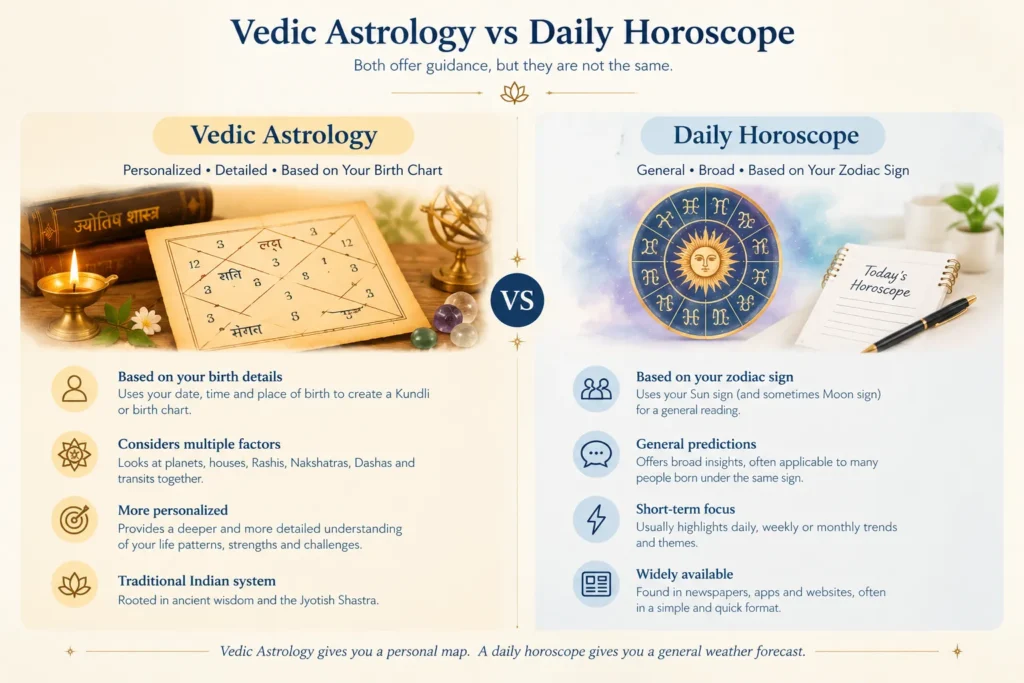
A daily horoscope generally offers broad, generic information based only on a Sun sign, meant to apply to millions of people at once. A personalized Vedic Astrology reading, by contrast, uses an individual’s exact birth details and full Kundli, including houses, Nakshatras, and Dashas, for a far more specific and detailed interpretation.
Can Vedic Astrology Predict the Future?
Vedic Astrology is traditionally used to examine potential life patterns, planetary periods, and the timing of opportunities or challenges, rather than to guarantee specific outcomes. It offers a framework for understanding tendencies and phases of life, but does not scientifically guarantee future events. It is best used as a tool for guidance and self-understanding, alongside one’s own judgment.
FAQs
What is Vedic Astrology?
A traditional Indian system, also called Jyotish, that interprets planetary positions using a person’s birth details.
How does Vedic Astrology work?
Through a Kundli built from date, time, and place of birth, combined with houses, Nakshatras, and planetary periods.
Is Vedic Astrology the same as a horoscope?
No. A horoscope is generic and sign-based; Vedic Astrology uses a full, personalized birth chart.
Does birth time matter?
Yes, it affects the Lagna and other key chart details.
Is Vedic Astrology the same as Western Astrology?
No. Vedic Astrology uses the sidereal zodiac and emphasizes the Moon sign, Nakshatras, and Dashas; Western astrology uses the tropical zodiac.
Ready to Understand Your Kundli?
Book a personalized Vedic astrology consultation — in person or online.